Helen Cammock: I Decided I Want to Walk
Helen Cammock: I Decided I Want to Walk
7 Octubre 2020
Cierra: 17 octubre 2020
Kate MacGarry announces Helen Cammock’s first exhibition at the gallery. Cammock explores social histories through film, photography, print, text, song and performance. She is motivated by her commitment to questioning mainstream historical narratives around blackness, womanhood, wealth, power, poverty and vulnerability. Mining her own biography in addition to the histories of oppression and resistance, multiple and layered narratives reveal the cyclical construct of histories.
The exhibition features Cammock’s new film They Call It Idlewild. The work acts as a reflection on the politics of idleness and what it means creatively, emotionally and culturally to be idle at a time when questions are being asked more widely about the physical and emotional costs of hyperproductivity required by neoliberalism. Cammock explores the processes of idleness through visual and poetic intertextuality, drawing on writers such as Audre Lorde, Mary Oliver, James Joyce and Jonathan Crary. Partway through the film, Cammock begins to sing Johnny Mercer’s Depression Era song Lazy Bones, drawing an explicit link between several historical periods, a reminder of the pervasiveness of racial stereotypes around laziness and the toxic hypocrisies of the slave business and land-owning classes. They Call it Idlewild asks: who gets to be lazy?
They Call It Idlewild was first exhibited at Wysing Arts Centre, Cambridge in March 2020, following a residency responding to the forgotten histories, photographs and artworks uncovered in the organisation’s archive. Cammock’s film has gained currency with the pandemic. Observation and patience are offered alongside urgent conversations of complacency and collusion.
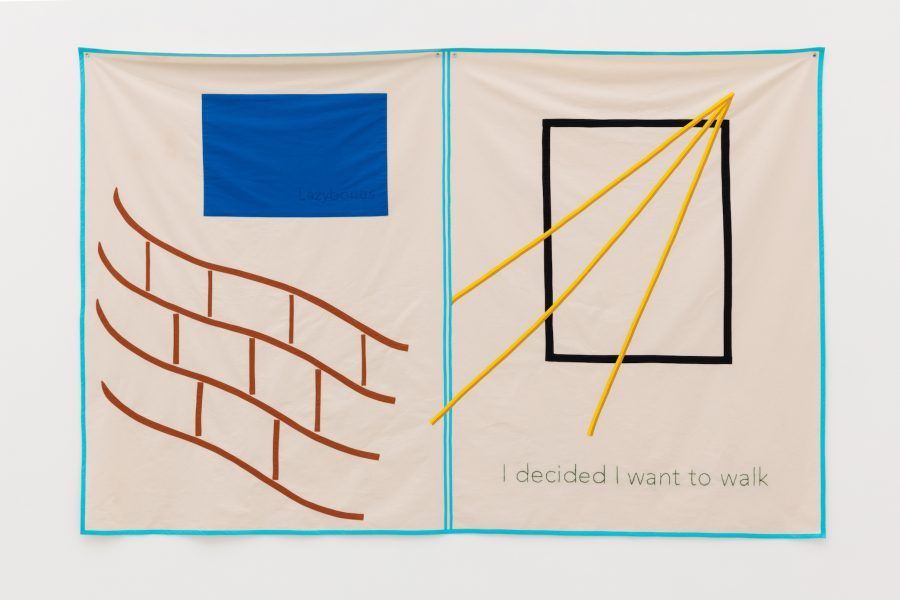
A large calico banner made in direct relation to the film is presented in I Decided I Want to Walk. Its forms reference the film’s landscape and its intention. The content, ideas and process of the film’s construction are recalled, in dialogue with histories of protest, the relationship to marginal experience and labour rights.
A set of new silkscreen prints respond to a moment past and current – political and social – individual and collective – asking how one exists without the other. Through the poetic quality and potential of language these propositions, and perhaps provocations, ask us to pay attention.
Helen Cammock was born in 1970 in Staffordshire. She lives and works between Brighton and London. Cammock was the joint recipient of The Turner Prize 2019 and the 7th Max Mara Art Prize for Women. Recent exhibitions include Wysing Arts Centre, Cambridge, UK (2020); Collezione Maramotti, Italy (2020); Whitechapel Gallery, London (2019); Turner Contemporary, Margate, UK (2019); VOID, Derry, Northern Ireland; The Irish Museum of Modern Art, Dublin (2019); Reading Museum, UK; Cubitt, London (2017). Her work has been included in group exhibitions at Kunsthaus Bregenz, Austria; Hamburger Kunsthalle, Hamburg, Germany; Somerset House, London; Hollybush Gardens, London, and Firstsite, Colchester, UK. She has staged performances at Turner Contemporary, Margate; Collezione Maramotti, Italy; The Showroom, London; Whitechapel Gallery, London; Cubitt, London; VOID, Derry, Northern Ireland and the ICA, London.
Más artículos de
Beyond Representation
7 dic 2023–31 dic 2026
C& América Latina cura programa de cine para Cinelogue con películas de directores Afroindígenas
1 jul–31 dic 2026
Dignidade e luta: Laudelina de Campos Mello
16 may–22 nov 2026
M’barek Bouhchichi: Les mains des poètes
24 abr–17 oct 2026
Belkis Ayón: Mito y desobediencia
16 jul–12 oct 2026

Cecilia Vicuña - El glaciar ido
30 abr–20 sept 2026