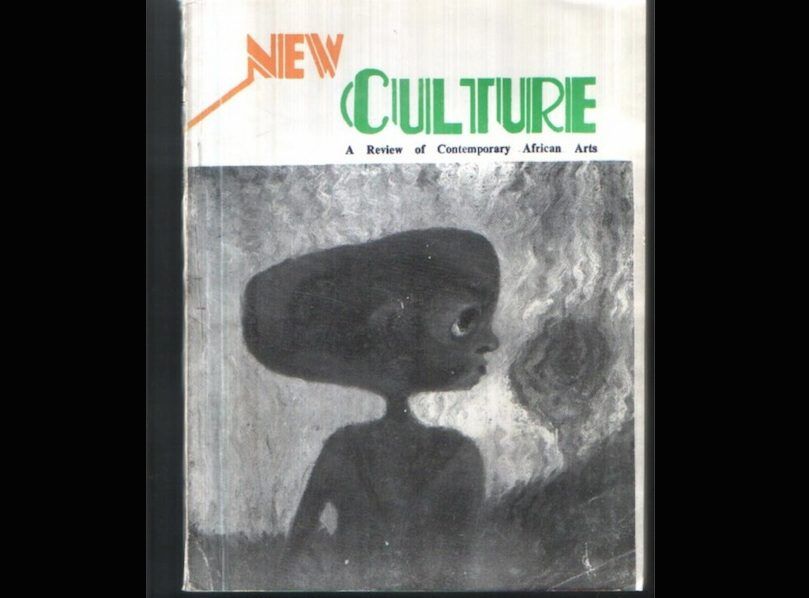
New Culture, A Review of Contemporary African Arts (b.1978—d.1979)
18 Mars 2014
Magazine C&
5 min de lecture
C& is happy to publish this feature by Bisi Silva as second part of a collaboration with the Manifesta Journal: This was initially published in the Journals’ current issue “Future(s) of Cohabitation” .
</a>
New Culture Mag,November 1978, 1979. Courtesy of New Culture Studios.
<a href="http://3.230.254.106/wp-content/uploads/2014/03/05-3.jpg">
</a>
New Culture Mag,November 1978, 1979. Courtesy of New Culture Studios.
The review delved into many such issues such as identity, colonialism, post colonialism, as well as history and tradition as they came to highlighting the new African reality, and the way these were engaged by the artists in their work. The key section of the review focused on the aesthetics of African Art and Culture, which propounded a return to the study of traditional art— which the founder, artist, architecture, poet and writer, Demas Nwoko (1935 - ) considered to be the “only one art stylistic idiom… valid to the African and the Blacks of African descent the world over, its origin being the too well-known form of traditional African arts, a form that was created and nurtured to maturity by African people themselves, with a history that dates beyond 2000 years.” In espousing a return to the past he also acknowledged the need for “a new aesthetic position relevant to our time.”5 To achieve these objectives, the reviewers covered the arts across the continent. The drawings by Sudanese artist Ibrahim El Salahi (1930– ) that were featured in the May 1979 issue are such an example, as they reached out to the diaspora. The eleven editions are filled with reviews and essays, in addition to containing a vibrant children’s section that makes palpable the dynamism of the cultural and creative sector of the period. The exhibition review I found to be the most illuminating was that of Theresa Luck-Akinwale (1934– ),6 one of the few trained female artists in Nigeria who still remains inadequately represented in the history of Nigerian Art. As such, the eleven editions constitute an indispensable archive of our cultural life in a context where such information remains difficult to find.
<a href="http://3.230.254.106/wp-content/uploads/2014/03/05-4.jpg">
</a>
<b>Title refers to: Volume 1, no. 1, November 1978, through Volume 1, no. 11, October 1979.</b>
<span style="text-decoration: underline;"> </span>
<ul>
<li>1.
Drum Magazine (initially called <i>African Drum</i>) was started in South Africa in 1951 by Bob Crisp and Jim Bailey. It was a lifestyle magazine that targeted the Black population. However it became popular for its coverage of township life under apartheid in the 1950s and 1960s. <i>Black Orpheus</i> was founded in 1957 in Nigeria by German expatriate Ulli Beier as a journal of African and Afro-American literature. <i>Transition: A Journal of Arts, Culture and Society</i> was started in Kampala, Uganda in 1961 by Rajat Neogy as a platform for East African intellectuals.</li>
<li>2.
Full disclosure, the writer is the director of CCA, Lagos.http://www.ccalagos.org, accessed December 23, 2013.</li>
<li>3.
<i>Nigeria Magazine</i> may be the longest running arts and culture magazine in Africa. It was founded in the 1930s and the final volume was in 1990.</li>
<li>4.
<i>USO: Nigerian Journal of Art</i> came out sporadically, only managing to release three publications in three Volumes (one edition per year) between December 1995 and December 2001.</li>
<li>5.
<i>New Culture Magazine</i> (November 1978), 1.</li>
<li>6.
Pat Oyelola. 1979. “The Art of Theresa Luck Akinwale”, <i>New Culture Magazine</i>, 21.</li>
</ul>
.
.
C& is happy to publish this review as second part of a collaboration with theManifesta Journal<b><i>: The review was initially published in the Journals’ current issue “Future(s) of Cohabitation” .</i></b>manifestajournal.org
Articles
Seed Archives: Thabo Weaves a Cocoon for Listening
Naafia Naahemaa: What Appears Solid Is Already In Motion
We're Still Here: Thero Makepe’s Visual Jazz
Articles
C& Highlights of 2025
Maktaba Room : annotations sur l’art, le design et les savoirs diasporiques