Werewere Liking: Of Spirit, Sound, and the Shape of Transmission
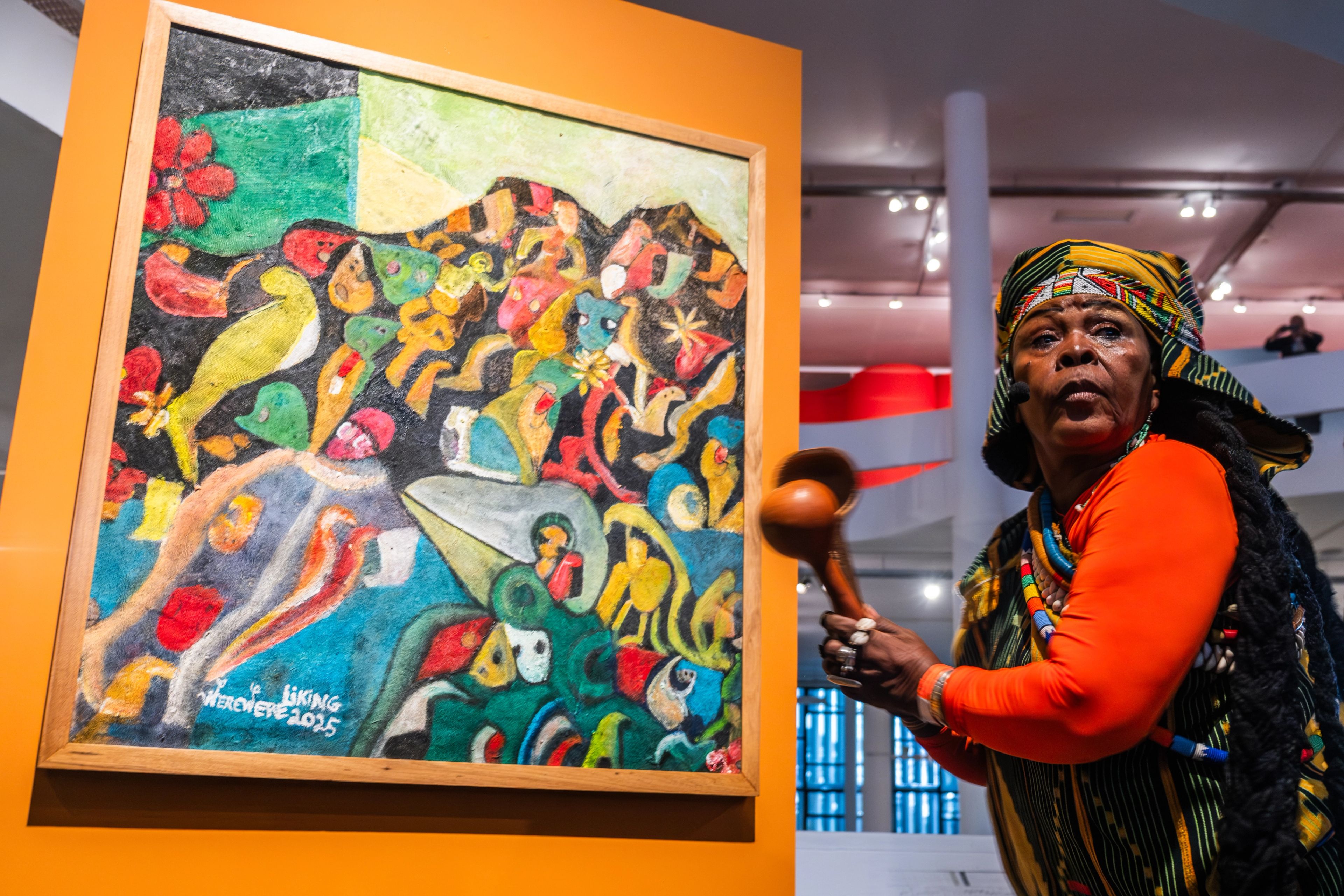
Performance by Werewere Liking, featuring performers Midria, Bia Ferreira, Janaina Silva, and Luz Ribeiro, in the work of Werewere Liking, on the second floor, during the 36th São Paulo Biennial. 07/09/2025 © Iza Guedes / Fundação Bienal de São Paulo
Remarking on the expanded perspectives encouraged by Cameroonian artist-performer Werewere Liking’s offering at the 36th São Paulo Biennial, writer Keren Lasme highlights symbolic, spiritual, and geographical references embedded within the works. As a nod to the broader curatorial arc and in the act of inviting communion, Lasme traces ancestral throughlines from Abidjan where the artist cultivates community at the Village Ki-Yi, to São Paulo where she unveiled a compelling performance piece. The biennial runs from 6 September 2025 to 11 January 2026.
Listen. Not just with your ears, but with what artist-performer Werewere Liking calls les oreilles de l’intérieur (the inner ears). The ones that hear what the hands feel, what the canvas murmurs, what the spirit remembers. At the 36th São Paulo Biennial, this call to expanded perception – from vision as vibration, to image as invocation – unfurls across Liking’s offering: a constellation of paintings, sculptures, sound, and a performance rooted in théâtre rituel, an approach the artist developed using inspiration from gestures and healing rituals.
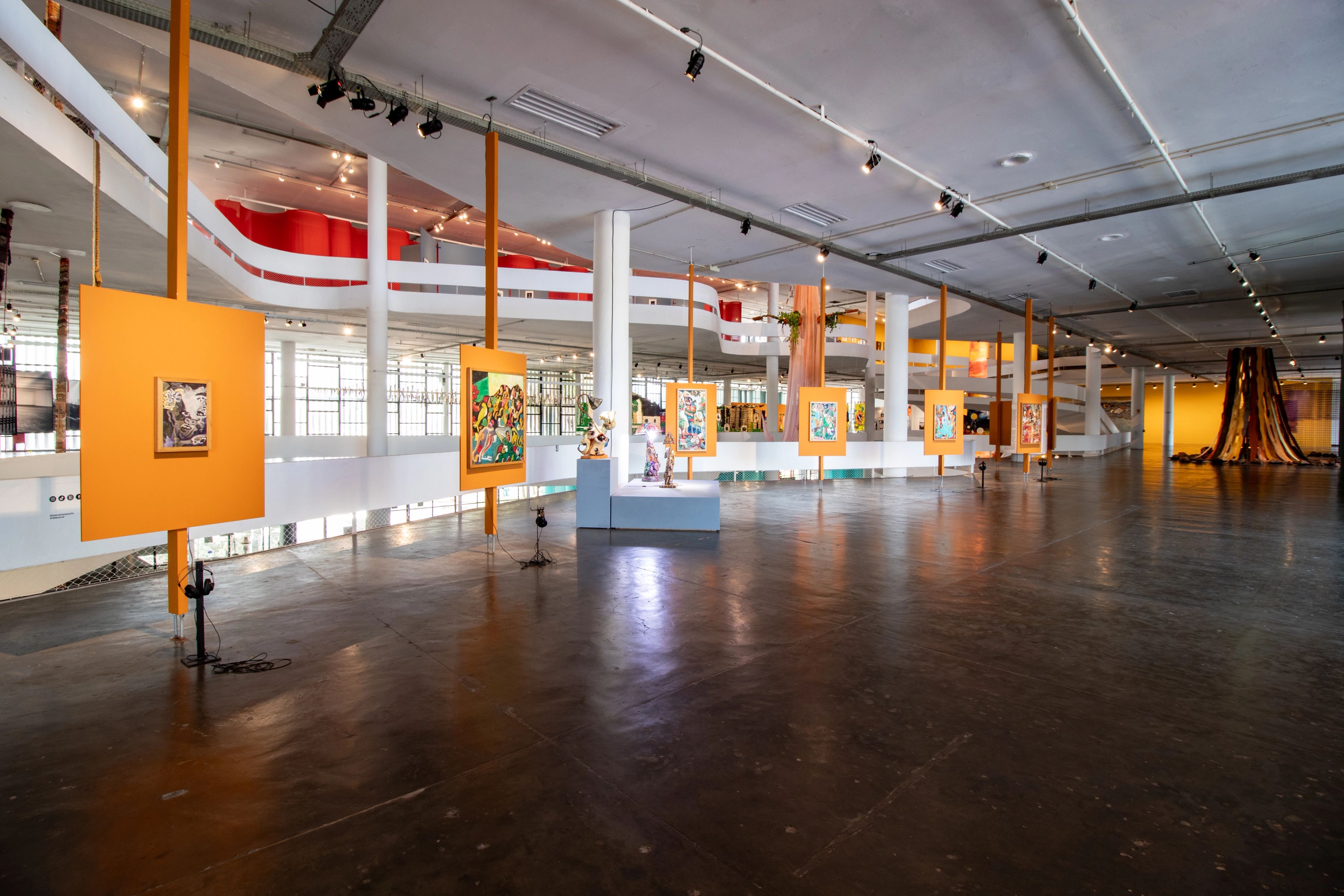
Installation view of Werewere Liking’s works at the 36th São Paulo Biennial. 15/09/2025 © Natt Fejfar / Fundação Bienal de São Paulo
Each artwork is alive with multiple voices. The painted sculptures, the sculpted paintings, and the poems sung and spoken form an ecosystem of memory and resonance. Viewers wearing headphones encounter each piece not in silence, but through sound compositions mostly based on Liking’s poetry. Five objects and five soundscapes: from the haunting cadence of Les Usuriers des Serments, a triptych exploring the weight of promises and the responsibilities they entail, to the invocation of the mythic Senufo bird, a keeper of wisdom in Les Descendants du Kalao. A small glowing canvas paid homage to late African art collector Eric Robertson, a mentor through whom Liking learned to read codes of ancestral form.
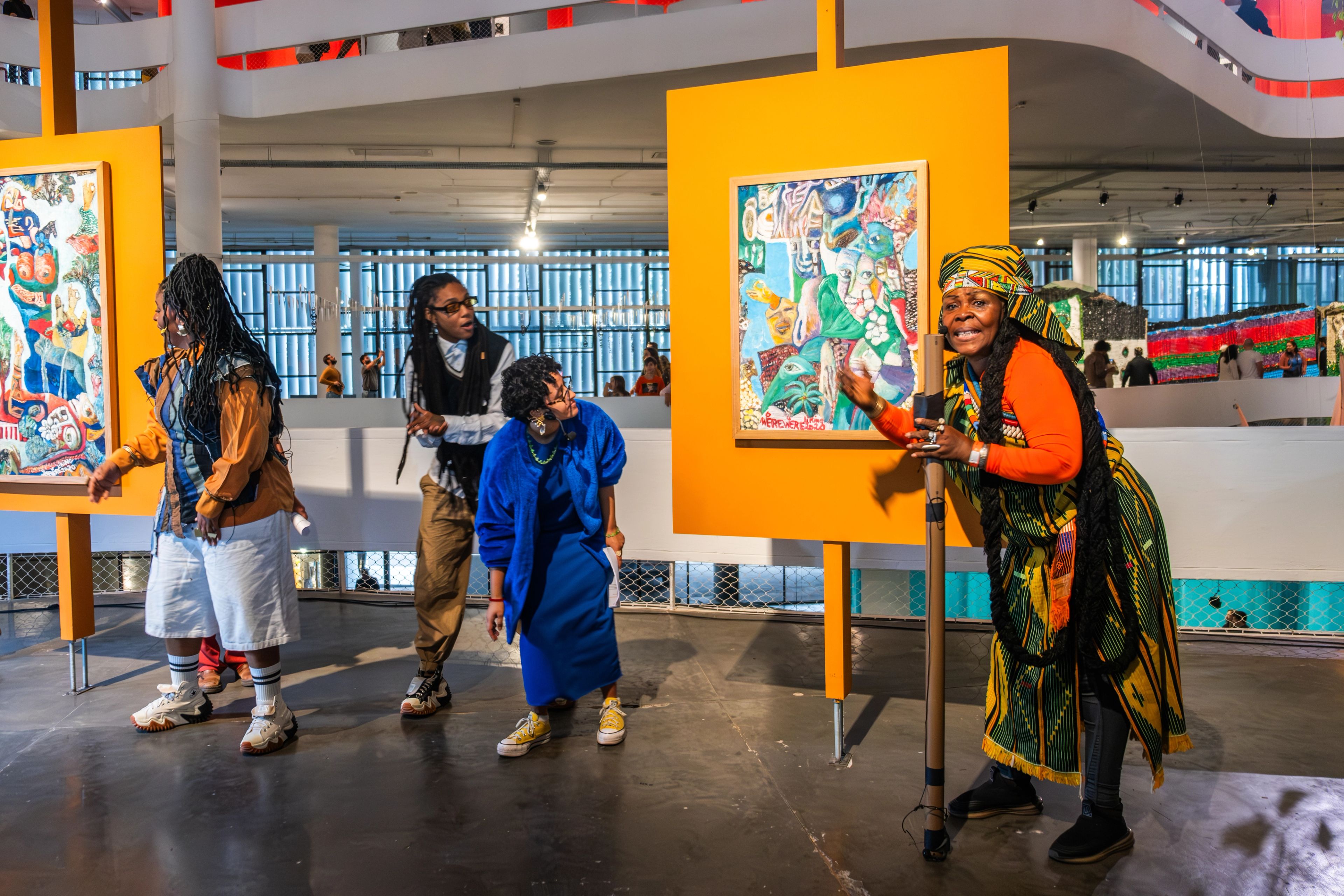
Performance by Werewere Liking, featuring performers Midria, Bia Ferreira, Janaina Silva, and Luz Ribeiro, in the work of Werewere Liking, on the second floor, during the 36th São Paulo Biennial. 07/09/2025 © Iza Guedes / Fundação Bienal de São Paulo
The installation doesn’t merely display objects but invites communion. Audiences nod, then sway, then dance. “I wanted a plural gaze,” Liking explains, “not just from what we see, but from what we often hear inside ourselves.” This approach dissolves hierarchies between medium and senses. Painting becomes poetry, sculpture sings, music takes shape.
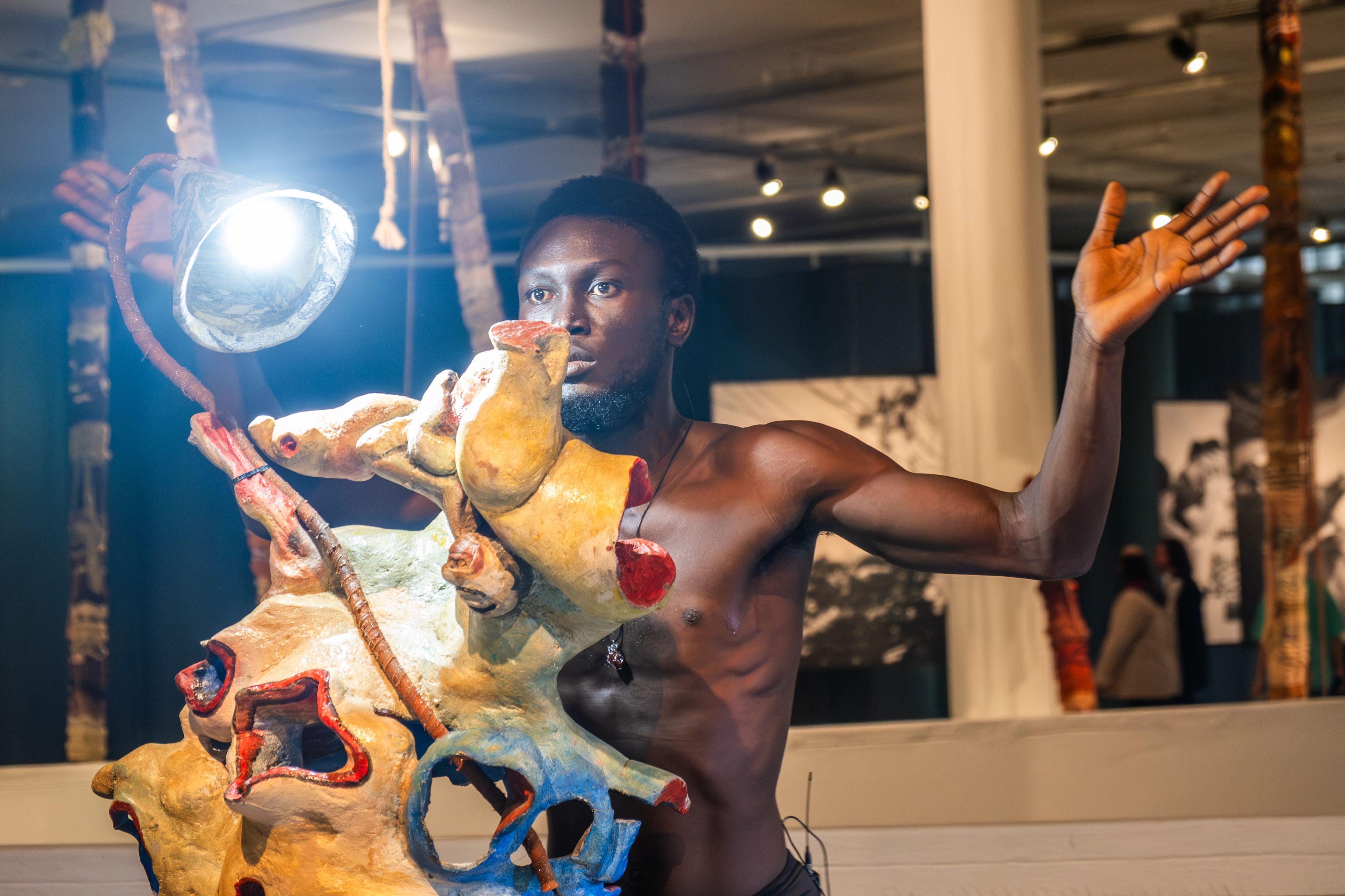
The performance took place on September 7 alongside the installation. Conceived in collaboration with Lamine, a pupil of the Village Ki-Yi in Abidjan who accompanied Liking to São Paulo, as well as four Afro-Brazilian slam poetesses and a musician – Midria, Janaina Silva, Luz Ribeiro, and Bia Ferreira respectively. It unfolded as an improvised ritual, moving in waves, a shared breath between elders and emerging voices. If the installation opened a space of dialogue between disciplines, the performance extended that dialogue across generations and geographies.
I wanted a plural gaze, not just from what we see, but from what we often hear inside ourselves.
This intergenerational interaction echoed the biennial’s broader curatorial arc. At a moment when cultural memory is fractured by urgency, extraction, and spectacle, Liking’s work insists on care, relation, and the slowness of transmission. A strong resonance can be found with Cuban artist María Magdalena Campos-Pons, whose ecstatic musical performance at the biennial on September 8 also embodied théâtre rituel, as a communal healing ceremony anchored in love and the act of gift-giving. Campos-Pons’s vision proposing forms of cultural continuity characterized by affection, reciprocity, and shared presence, converse with the ethos that Liking has cultivated throughout her life-long project, the Village Ki-Yi.
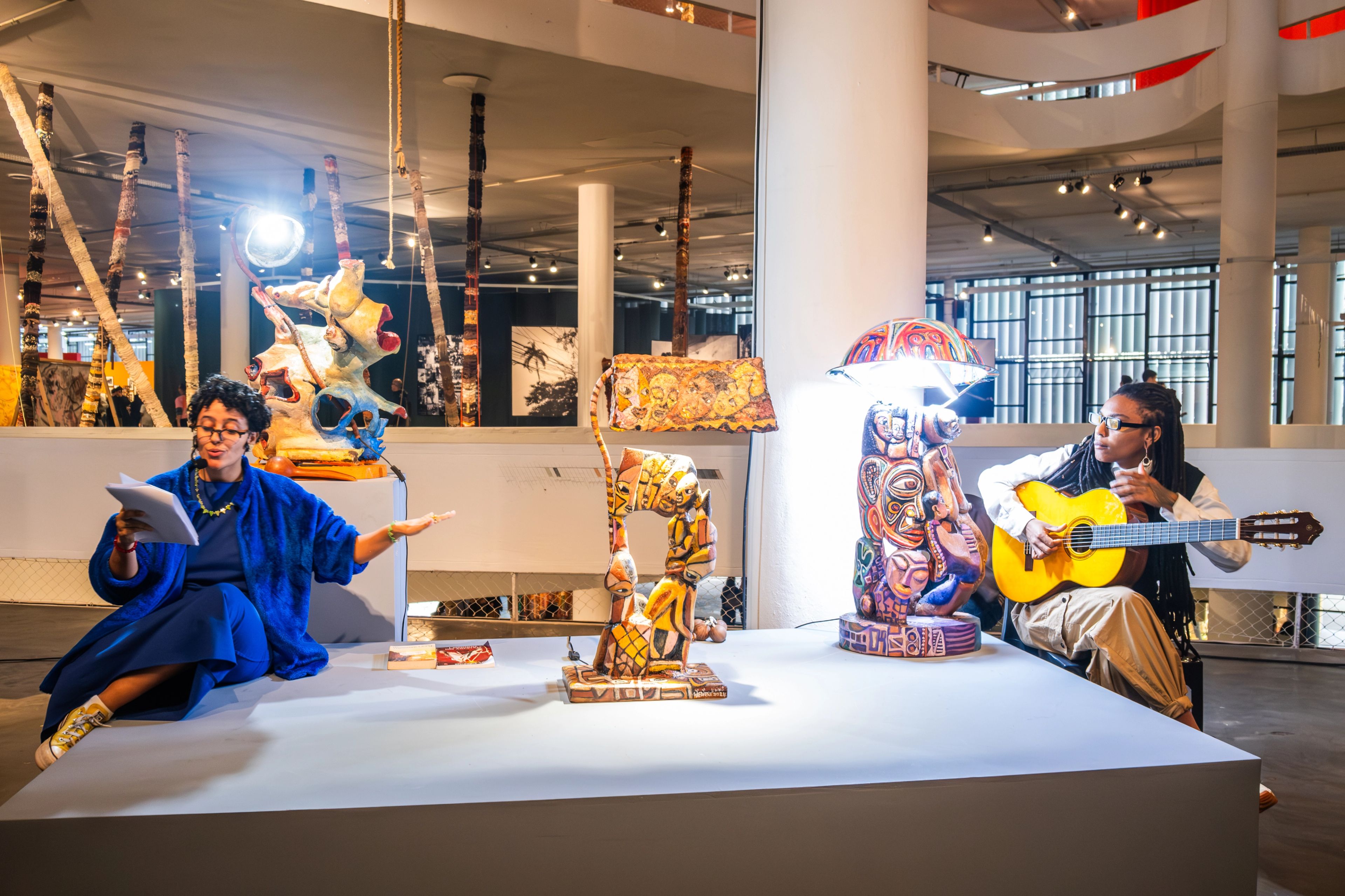
Midria and Bia Ferreira during Werewere Liking’s performance, which also featured performers Janaina Silva and Luz Ribeiro, presented within Werewere Liking’s work on the second floor of the 36th São Paulo Biennial. 07/09/2025 © Iza Guedes / Fundação Bienal de São Paulo
Performance by Werewere Liking, featuring performers Midria, Bia Ferreira, Janaina Silva, and Luz Ribeiro, in the work of Werewere Liking, on the second floor, during the 36th São Paulo Biennial. 07/09/2025 © Iza Guedes / Fundação Bienal de São Paulo
Now in its fortieth year, Ki-Yi is not simply a training ground. It is a breathing institution, a community space, a home and vessel of ancestral knowledge. Over the past year, it has nurtured and mentored hundreds of artists, including nationally and internationally acclaimed figures like Dobet Gnahoré and Didi B. The fortieth anniversary celebration will culminate in December 2025 with an international colloquium and a harvest ritual – a way to reflect, sow, and begin again.
In both São Paulo and Abidjan, Liking reminds us that art is a portal. Each creation is alive, inseparable from the gestures, sounds, silences, and spirits that surround it. It demands reverence and listening – not only to what it says, but to what it activates in us. At a time when ancestral epistemologies and knowledge still struggle to find their rightful place, Liking’s work is insurgent. It does not seek to preserve the past but to reawaken its frequencies through the bodies, tongues, and visions of the present.
Sobre o autor
Keren Lasme
Keren Lasme is an artist, writer, and literary curator whose work is concerned with mythopoetic identity formation, knowledge activation, and the use of fiction and imagination as spatiotemporal technologies for inner and outer worldbuilding. Her art practice engages with collective care, engaged pedagogy, and the politics of pleasure while using the collective memories and imagination archived in African literatures as praxis.
Resenhas
The Re:assemblages Symposium: How Might We Gather Differently?
Paris Noir: Pan-African Surrealism, Abstraction and Figuration
Samson Mnisi: A Master Posthumously Receives His Due
Resenhas
Image Interventions in The African Gaze
FESPACO 2025 Made Space for the Ceremony of African Cinema